Weekly Credits with Monthly Billing
"I want 3 sessions per week, but bill me on the 1st of each month."
If you run a gym, you've heard this request. And you probably said yes without thinking about it too hard. Why would you? It sounds completely reasonable.
The gym wants consistency. 3 sessions every week, not a random pile of 12 sessions per month the client can front-load or ignore. The gym wants the member training regularly.
The member wants a predictable billing date. The 1st. Or the 15th. Or even their signup date. That's fine too. The point is they want to know exactly when the charge hits every month. What they don't want is a billing date that shifts around because the system bills every 4 weeks instead of monthly, landing on a different day each month with no pattern they can predict.
Both of these are totally reasonable requests. But here's the thing most gym owners don't realize:
You can't have both without some serious math behind the scenes.
Weekly credits and monthly billing don't divide evenly. And if your billing system doesn't account for that, someone's getting shortchanged. Either the gym or the member.
The Math: 52 Weeks, 48 Weeks, and Where the Other 4 Go
A year has 52 weeks. But if you bill monthly and assume 4 weeks per month, that's only 48 weeks. Where do the other 4 weeks go?
Let's make it concrete. Sarah pays for 3 PT sessions per week. Monthly billing on the 1st.
If you give Sarah 12 sessions per month (3 × 4 weeks), she's getting 144 sessions per year. But 3 sessions × 52 weeks = 156 sessions. She's short 12 sessions. An entire month's worth.
| Approach | Sessions/Month | Sessions/Year | Correct? |
|---|---|---|---|
| 3/week × 4 weeks/month | 12 | 144 | Missing 12 sessions |
| 3/week × 52 weeks/year | — | 156 | Correct yearly total |
If you give Sarah 13 sessions per month to compensate? That's 156 per year, correct total. But now you've broken the "per week" part. 13 doesn't divide evenly into weeks. What are the rules? Can she use 5 in one week and 1 the next? Is that still "3 per week"?
The Workarounds Everyone Uses
If this problem sounds familiar, you've probably tried one of these solutions. Each one fixes one thing and breaks another.
Give 12 Per Month
Easiest to implement. But the member is paying for 3 per week and getting less than that 4–5 months out of the year, the months with 5 weeks. Some members notice. Some don't. But you're technically billing for sessions you're not providing, and that's a bad look if it ever comes up.
Give 13 Per Month
Fixes the yearly total. But now "3 per week" is meaningless. They have a pool of 13 and can use them however they want. You can't enforce weekly consistency unless someone is manually watching every account. And what happens in months that genuinely only have 4 weeks of activity?
Bill Every 4 Weeks Instead of Monthly
Keeps the weekly math clean. 4 weeks × 3 = 12, perfect. But now you have 13 billing periods per year and the billing date changes every month. February 1st, March 1st, March 29th, April 26th... Your members can't predict when they'll be charged, which is the opposite of what they asked for. Your accountant hates it. Month-end reconciliation becomes meaningless because billing cycles don't align with calendar months.
Call It Unlimited
Some gyms just absorb the problem. But then you lose the ability to manage capacity, track attendance patterns, or enforce the consistency the member signed up for.
How We Solved It
We built the billing system to treat weeks and months as two separate rhythms that work together automatically.
Billing happens monthly. On the 1st, the 15th, or your member's signup date. The date never changes. Predictable for the member, predictable for you.
Credits are granted weekly. Every Sunday through Saturday. The system looks at how many weeks fall within each billing period and grants credits for each one.
The screenshot below shows Sarah Nguyen on a 3x weekly PT membership billed on the 1st. The membership card shows the monthly price, the weekly credit rule, the trainer restriction, and the individual weekly buckets tied back to the invoice that created them.
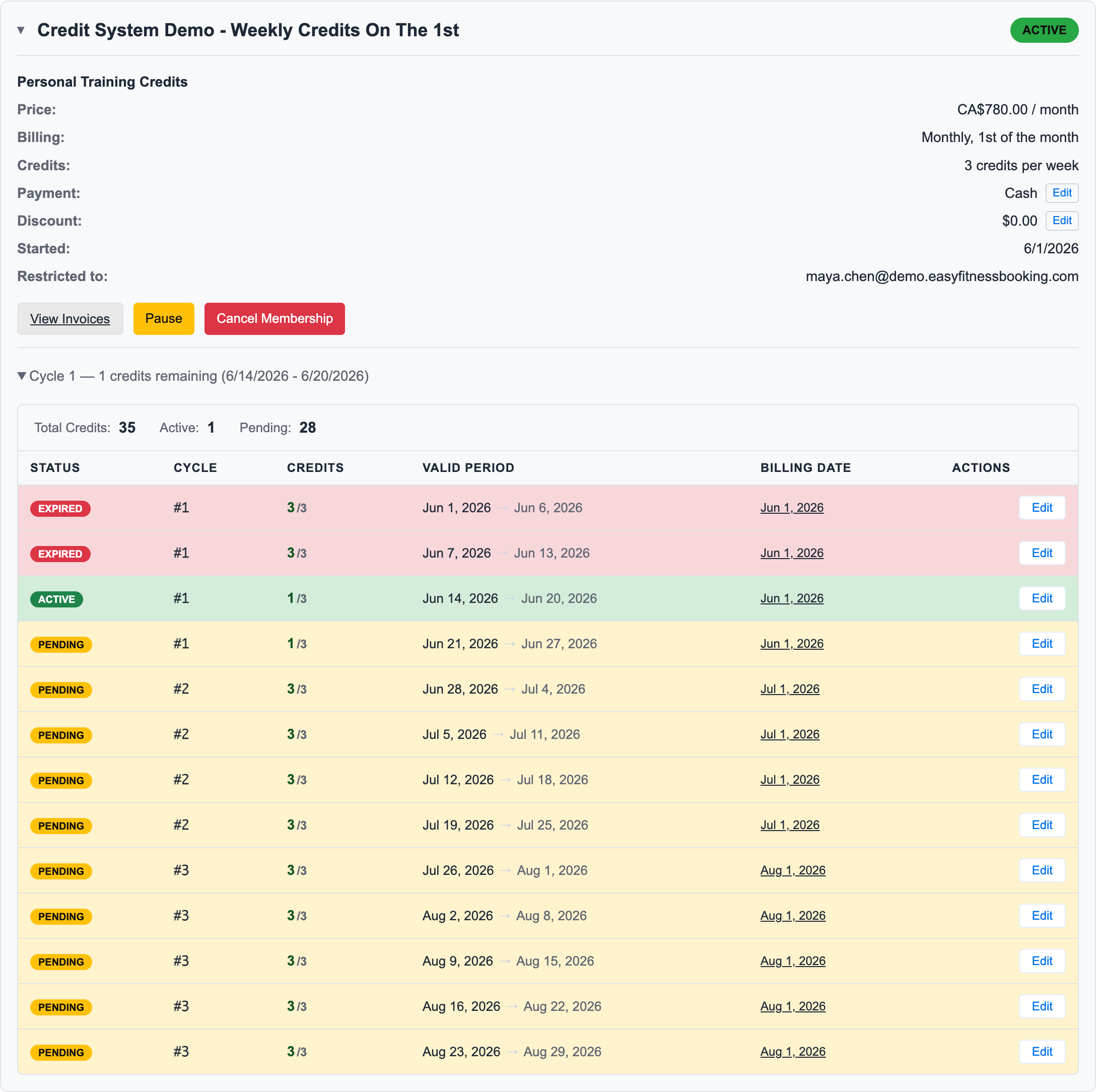
The Product Rule: The Bucket Belongs To The Invoice Where The Week Ends
For normal fixed-weekly billing, Easy Fitness Booking assigns each weekly credit bucket based on the bucket's end date.
That rule is what keeps the month-end math predictable:
| Weekly bucket | Invoice that owns it | Why |
|---|---|---|
| Jun 1-6, 2026 | Jun 1 invoice | The bucket ends in June |
| Jun 7-13, 2026 | Jun 1 invoice | The bucket ends in June |
| Jun 14-20, 2026 | Jun 1 invoice | The bucket ends in June |
| Jun 21-27, 2026 | Jun 1 invoice | The bucket ends in June |
| Jun 28-Jul 4, 2026 | Jul 1 invoice | The bucket ends in July |
That last row matters. Sarah still sees a weekly bucket starting on June 28, but it belongs to the July 1 invoice because the bucket ends on July 4. This avoids double billing and avoids a gap between months.
What If The Membership Ends On June 30?
This is where the system has to be more careful than a spreadsheet.
If Sarah cancels and your policy honors the current paid period through June 30, the system does not leave the full Jun 28-Jul 4 bucket on the July invoice. It automatically adjusts the boundary bucket so coverage ends on the exact correct day.
For a 3x weekly plan, that means the Jun 28-Jul 4 bucket can be moved and shortened to Jun 28-Jun 30 with the correct partial credit count. Sarah gets the access she paid for through the end of June, but she is not left with July credits after the membership should be finished.
The short version:
- Normal billing assigns weekly buckets by the bucket end date.
- Cancellation and pause/resume workflows can split, move, shorten, or shift boundary buckets.
- The final result is that the member's credits end on the correct date, not on an arbitrary Saturday.
A Normal Month
Sarah's February 1st invoice: $780. The system counts the weekly periods in February:
February Invoice ($780):
├── Week of Feb 1-7:   3 credits
├── Week of Feb 8-14:  3 credits
├── Week of Feb 15-21: 3 credits
└── Week of Feb 22-28: 3 credits

Total: 12 credits across 4 weekly buckets
Each week Sarah has exactly 3 sessions available. They show up on Sunday, and she has until Saturday to use them. Nothing surprising.
A Month with 5 Weeks
Here's where it gets interesting. March 1st invoice: still $780. But March has 5 weekly periods:
March Invoice ($780):
├── Week of Mar 1-7:   3 credits
├── Week of Mar 8-14:  3 credits
├── Week of Mar 15-21: 3 credits
├── Week of Mar 22-28: 3 credits
└── Week of Mar 29-Apr 4: 3 credits

Total: 15 credits across 5 weekly buckets
Sarah gets 15 sessions in March but still pays $780. She's not being shortchanged. She's getting her 3 per week, every week, no gaps.
The philosophy is simple: the client is paying monthly, so we bill based on time. If a month has an extra week, we give the credits for that week. Over the course of the year, it all evens out. Sarah is paying for 3 per week and she gets 3 per week. The billing just happens to land monthly.
No spreadsheets. No manual tracking. No members getting shorted.
What Happens When Sarah Signs Up Mid-Month
The signup experience sets the tone for the entire member relationship. If the first interaction involves confusing math or a charge that feels unfair, you're starting behind.
Sarah joins your gym on Saturday, January 10th. She wants 3 sessions per week, billed on the 1st of each month. January 1st already passed. What happens?
The important detail: the membership start date is the first day Sarah is allowed to train. If staff start her membership on January 10th, the system assumes she could book a session that day. If Sarah is not actually starting until Sunday, January 11th, or Monday, January 12th, staff should set the membership start date to that first training day instead.
Prorated First Invoice
Sarah's first invoice is prorated based on the credits she actually receives, not just the number of calendar days left in the month.
The system works in this order:
- Build the weekly credit buckets Sarah will receive before her next full billing date.
- Calculate any partial-week credits.
- Round partial-week credits up to whole usable sessions.
- Price the invoice from the credits granted.
For Sarah, the remaining January invoice covers 4 weekly buckets. A normal 4-week window would be 12 credits. Because January 10th is the last day of the first weekly bucket, Sarah receives 1 credit for that Saturday, then 3 credits for each full week after that:
- Normal credits in the invoice window: 12
- Credits granted: 10
- Prorated amount: $780 × (10/12) = $650.00
Fair to both sides. Sarah pays for the 10 credits she can actually use, not a full 12-credit month she didn't receive.
Credits for the Remaining Weeks
Between January 10th and January 31st, the system counts these weekly buckets:
First Invoice - Prorated ($650.00):
├── Jan 10:        1 credit  (Saturday start date)
├── Jan 11-17:     3 credits
├── Jan 18-24:     3 credits
└── Jan 25-31:     3 credits
That partial first week is the key detail. Because Sarah's membership starts on Saturday, January 10th, the system assumes she is allowed to train that day. Sarah gets 1 usable credit for January 10th, and the invoice charges for that credit. If she is not meant to train until Sunday or Monday, staff should set the membership start date to that first training day instead.
Back to Normal
February 1st: Sarah pays the full $780 and gets credits for every week in February. From here on out, she knows exactly when she's charged and exactly how many sessions she gets each week. The proration only happens once.
Here's what you tell Sarah at signup:
"Your membership is $780 per month, billed on the 1st. Since you're starting mid-January, today's charge is $650.00 for the 10 credits available before the next full billing cycle. Starting February 1st, you'll be charged the full $780 each month."
Clean. Simple. Sarah appreciates paying fairly for what she's getting.
The Pause That Unravels Everything
Everything above (weekly credits, monthly billing, the automatic reconciliation) gets significantly harder when a member pauses their membership. This is where manual systems fall apart.
Sarah has been training 3x per week, billed on the 1st, everything's running smoothly. Then she says: "I'm going on vacation. Can I pause for three weeks?"
What Happens When You Pause
The system handles the pause in a specific order:
- Credits are preserved. Sarah has 8 credits remaining across her upcoming weekly buckets. Those are saved. They don't disappear.
- Upcoming sessions are cancelled. But we still respect the 24-hour trainer rule. If Sarah has a session booked for tomorrow morning, the system flags it rather than silently cancelling a session that affects trainer pay.
- Billing stops. No charge on the next billing date.
- Everything is documented. The invoice shows exactly when the pause started, what credits were saved, and what sessions were affected.
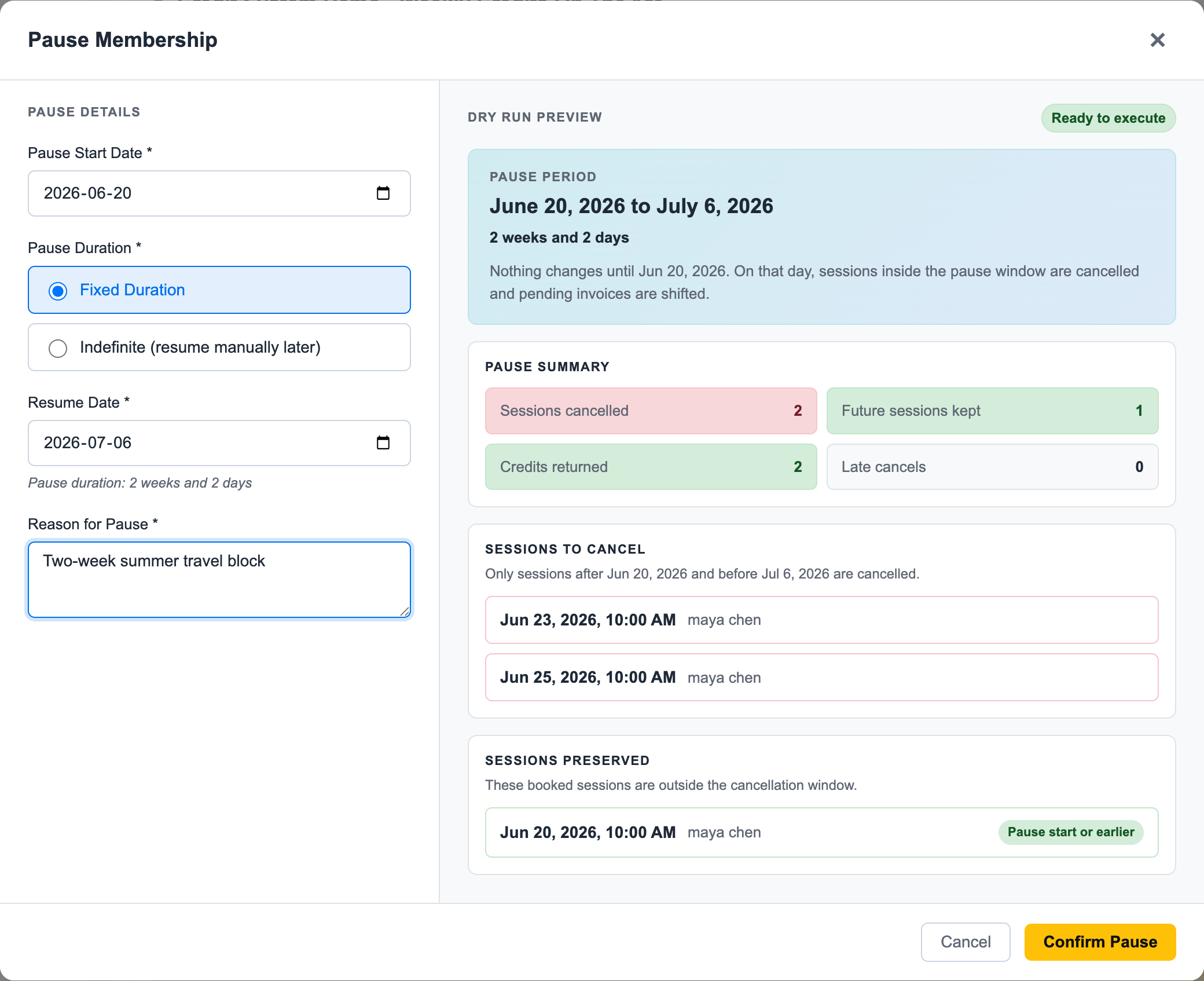
Before staff confirm the pause, the dry run shows the practical impact: which sessions will be cancelled, how many credits come back, and which sessions stay because they fall outside the pause window.
The Re-Alignment Problem
Sarah paused on January 15th. She comes back February 5th. Her next billing date would have been February 1st, but she was paused. Now what?
| Option | What Happens | Fair? |
|---|---|---|
| Charge for all of February | Sarah pays for a month she was mostly paused during | Unfair to Sarah |
| Wait until March 1st | Sarah trains for free for 24 days | Unfair to the gym |
| Bridge invoice | Sarah pays for exactly the credits she'll use between now and March 1st | Fair to both |
Saved Credits First, Then the Bridge Invoice
When Sarah resumes, she still has her saved credits from before the pause. She can use those right away. Then the system calculates how many additional credits Sarah will receive between her resume date (February 5th) and the next fixed billing date (March 1st), and prices each credit based on her plan rate:
Bridge Invoice Calculation:
├── Monthly rate: $780
├── Credits per month (assuming 4 weeks): 12
├── Cost per credit: $780 ÷ 12 = $65
├── Credits in bridge period: ~10-11
└── Bridge charge: $65 × credits granted
Sarah pays for exactly what she's getting. Not more, not less.
The Philosophy Behind the Pricing
The pause was already the benefit to Sarah. She got to stop paying while she wasn't training. When she comes back, we think the gym should be fully compensated for the sessions she uses. The bridge invoice isn't a penalty. It's a fair charge for sessions delivered.
We assume 4 weeks per month to calculate the per-credit cost because this slightly favors the gym, which we think is appropriate. The member already received the benefit of pausing.
Back on Track
March 1st rolls around. Sarah gets her normal $780 invoice with normal weekly credits. She's fully re-aligned with her billing cycle. No manual work. No spreadsheets. No "let me recalculate your account."
Pause Policies We Recommend
The pause/resume system works automatically, but you still need policies around when and how often members can pause.
Staff-Only Execution
Members can't pause their own memberships. Pauses are managed through the admin side of the software. The member requests it, and staff executes it. This gives you a touchpoint to understand why they're pausing and when they expect to return, and it prevents abuse.
Limit Pauses
Whether it's 1 or 2 per year, set a limit and communicate it upfront. Without a limit, some members will abuse the flexibility. A clear policy prevents that conversation.
Communicate Clearly
When a member asks to pause, explain what will happen:
"We'll freeze your billing and save your remaining credits. When you come back, you'll be able to use any credits you have left. If the system needs to grant new credits before your next normal billing date on the 1st, the bridge charge is based on those credits. Then you're back to normal billing from there."
No surprises. The member knows what to expect.
Why This Matters
This might seem like an obscure billing edge case. It's not. Every gym that offers weekly sessions with monthly billing runs into this math. Most just don't realize it. They're either shortchanging members, overcomplicating their billing, or managing it by hand.
We built this directly into the billing engine so it just works:
- Weekly credits + monthly billing reconciled automatically
- 5-week months handled without manual intervention
- Mid-month signups prorated fairly from the credits granted
- Pauses preserve credits and document everything
- Resume uses a bridge invoice to re-align to the fixed billing date
- No spreadsheets. No manual tracking. No members getting shorted.
It's one of those features that's invisible when it works. Which is exactly the point.
Related Topics
- Weekly Credits Explained — How Sunday-Saturday periods work
- Predictable Billing Dates — Why fixed-date billing beats the alternatives
- Pause & Resume — Full details on pausing memberships
- Credit Tracking — How every credit stays traceable
- Invoice Audit Trail — What your invoices track
Ready to streamline your gym?
Start managing bookings, personal training, and memberships in minutes.
Start Your Free Trial →No credit card required